Mastering Power to Weight Ratio in Rowing: Concept2 & On-Water Performance
Discover why power to weight ratio is the holy grail of rowing speed. Learn how to calculate your Watts/Kg, understand the difference between erg scores and boat speed, and optimize your physiology for peak performance.
Azeem Iqbal
Performance Analyst
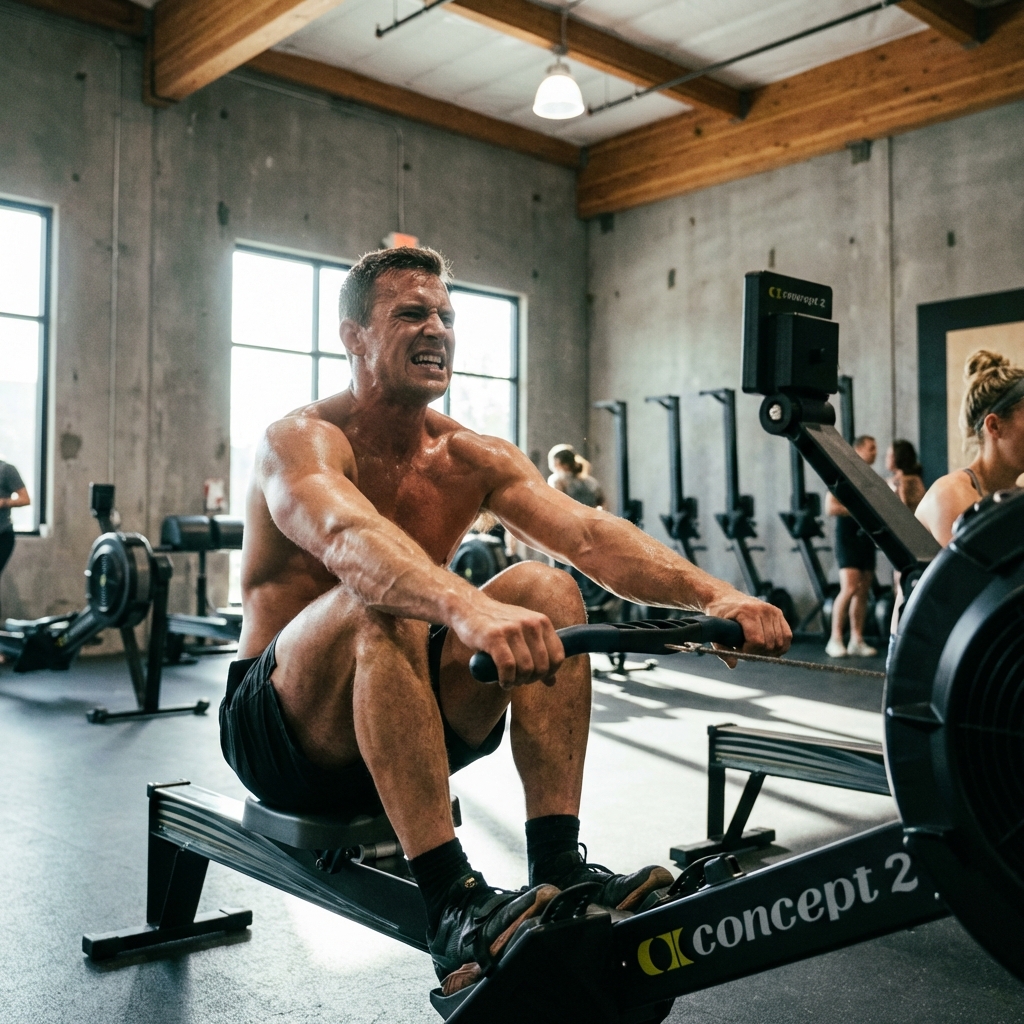
Table of Contents
- Mastering Power to Weight Ratio in Rowing: Concept2 & On-Water Performance
- The Physics of Rowing: Ergometer vs. On-Water
- Calculating Your Rowing Power to Weight Ratio (Watts/Kg)
- Lightweight vs. Heavyweight: The Eternal Debate
- Improving Your Ratio: Weight Loss vs. Power Gain
- Benchmarks: What is a Good Score?
- Conclusion: The data doesn’t lie
Mastering Power to Weight Ratio in Rowing: Concept2 & On-Water Performance
In the world of endurance sports, few metrics are as contested, analyzed, and critical as the Power to Weight Ratio (PWR). Cyclists live by it, runners fear it, but for rowers, it exists in a complex duality between the gym and the river. If you have ever pulled a personal best on the Concept2 ergometer only to find yourself trailing a smaller, lighter competitor on the water, you have experienced the brutal reality of rowing physics firsthand.
Rowing is a sport of leverage, lung capacity, and lactate threshold. But ultimately, it is a game of physics. How much force can you apply to the oar handle, and how much mass do you have to move across the finish line? This guide will dive deep into the mechanics of power to weight ratio in rowing, helping you understand how to calculate it, how to improve it, and why it might be the missing link in your training.
The Physics of Rowing: Ergometer vs. On-Water
To truly master rowing performance, one must understand the fundamental difference between “indoor speed” and “boat speed.” This distinction is where power to weight ratio shifts from a number to a defining characteristic of your athletic profile.
The Concept2 Ergometer: The Land of Absolute Power
The Concept2 Indoor Rower is the gold standard for testing rowing fitness. It provides a standardized measure of work potential. However, the machine is stationary. When you drive your legs down, you are spinning a flywheel, not moving your body mass through a fluid medium.
On an erg, Absolute Power (Watts) is king. If Athlete A weighs 100kg and pulls 400 Watts, and Athlete B weighs 70kg and pulls 380 Watts, Athlete A will have a faster split time on the monitor. The machine does not “punish” Athlete A for the extra 30kg of mass they are carrying. It simply rewards the raw energy output delivered to the handle. This is why heavyweight rowers dominate indoor rowing championships—mass moves mass, and bigger engines (bodies) can produce more raw horsepower.
The Boat: Where Gravity and Drag Enforce the Rules
Step into a single scull, and the equation changes dramatically. You are no longer stationary. You are now a vessel displacing water.
Hydrodynamic Drag becomes your primary adversary. Drag is the resistance the water exerts on the hull of the boat. The amount of drag is directly influenced by the wetted surface area of the boat, which is determined by how deep the boat sits in the water.
- A heavier rower pushes the boat deeper.
- A deeper boat creates more drag.
- Therefore, a heavier rower must produce more power just to overcome the specific penalty of their own weight.
This is where Power to Weight Ratio (W/kg) reigns supreme. If that 100kg Athlete A from our previous example enters a boat, they are dragging a significantly heavier load than the 70kg Athlete B. Even though Athlete A produces 20 more Watts, it likely isn’t enough to offset the increased drag. Athlete B, with a far superior power to weight ratio, will likely cross the finish line first.
Calculating Your Rowing Power to Weight Ratio (Watts/Kg)
Understanding the theory is great, but let’s get down to the numbers. You don’t need a physics degree to track this metric; you just need your average watts and a scale.
The Formula
The formula is deceptively simple: $$ \text{Power to Weight Ratio} = \frac{\text{Average Watts}}{\text{Body Weight (kg)}} $$
Step-by-Step Calculation
- Test Yourself: Perform a standard test piece, such as a 2000m or 5000m row.
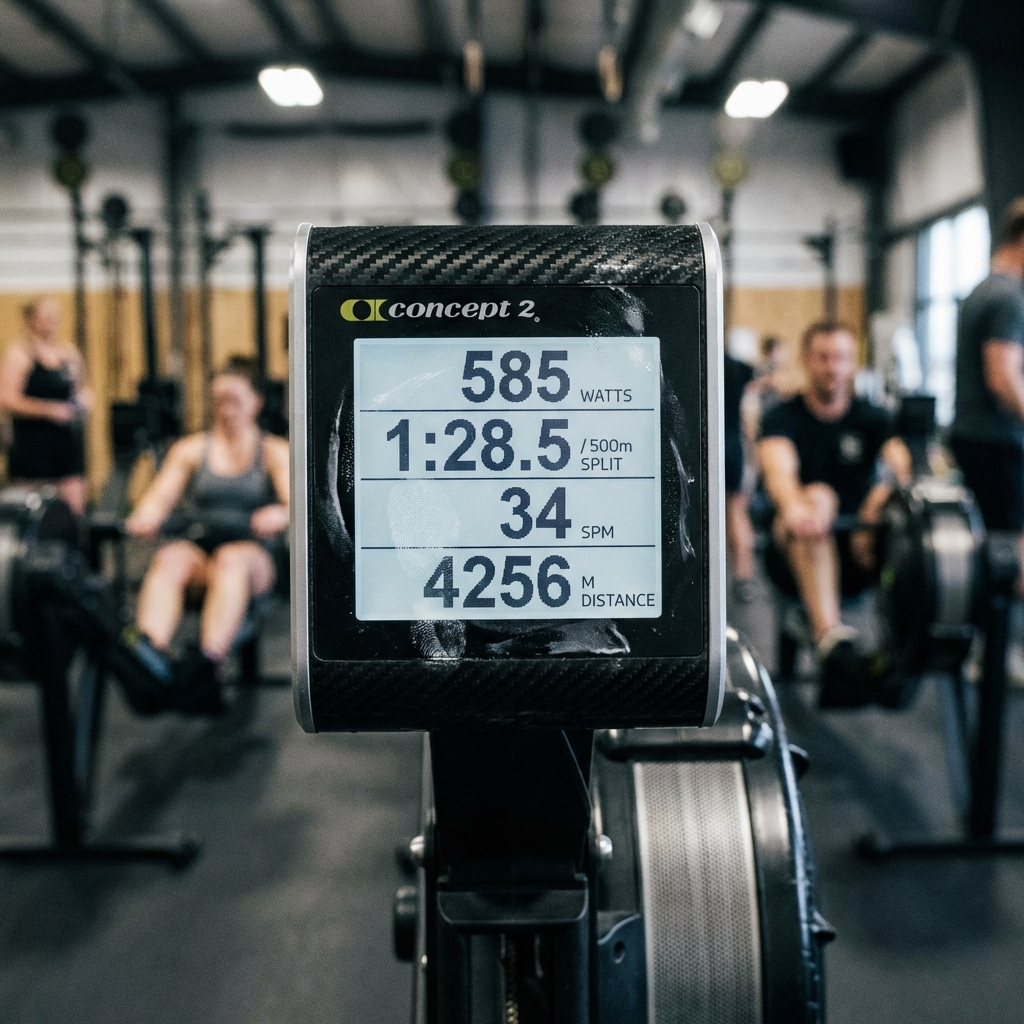
- Record Average Watts: Do not use split time (e.g., 1:45/500m) for this. Most monitors allow you to view “Avg Watts” in the memory or summary screen. Split time is non-linear (it takes exponentially more power to go faster), so Watts is the only linear metric that works for accurate math.
- Weigh In: Get your body weight in Kilograms.
- Divide: Divide the Watts by the Kg.
Example Scenario
Let’s look at two rowers competing for a seat in the top boat.
- Rower X: Weighs 90kg. Pulls a 6:20 2k. Average Watts: ~380W.
- Calculation: $380 / 90 = 4.22 W/kg$
- Rower Y: Weighs 72kg. Pulls a 6:28 2k. Average Watts: ~350W.
- Calculation: $350 / 72 = 4.86 W/kg$
On the erg, Rower X is 8 seconds faster, a massive margin. But Rower Y has a Power to Weight Ratio of 4.86 compared to 4.22. In a small boat (single or double), Rower Y is almost guaranteed to be faster. In a larger boat (eight), where the boat weight is distributed, Rower X’s raw power might still be valuable, but Rower Y is pound-for-pound the superior athlete.
Lightweight vs. Heavyweight: The Eternal Debate
Rowing is one of the few sports that explicitly splits competitors by weight, acknowledging the distinct physics disadvantage of lighter athletes. This has created two distinct cultures and training methodologies within the sport.
The Heavyweight Strategy
For open-weight or heavyweight rowers, the goal is Maximal Aerobic Power. While they cannot ignore body composition—fat is still dead weight that doesn’t help move the boat—they are not constrained by a scale. Their training often prioritizes absolute strength and peak wattage. They can afford to carry extra muscle mass even if it’s not purely endurance-focused, because the penalty for weight is less severe than the penalty for lack of power.
- Typical Training: Heavy compound lifts, high-resistance erg intervals, consumption of massive calories to fuel the “big engine.”
The Lightweight Strategy
For lightweights (Men < 72.5kg, Women < 59kg typically for crew averages), Efficiency is the religion. Every single gram of tissue on a lightweight’s body must serve a purpose. If it isn’t generating propulsion, it is slowing the boat down. Lightweight training is a delicate balance of maximizing VO2 max without triggering excessive hypertrophy (muscle growth) that would push them over the weight limit. They are the masters of PWR.
- Typical Training: Extreme volume steady-state (Zone 2) to build mitochondrial efficiency, high-velocity strength training (plyometrics) to gain power without mass, and strict nutritional periodization.
Improving Your Ratio: Weight Loss vs. Power Gain
So, you want to get faster. Should you lose weight or gain power? The answer depends entirely on your current body composition and training history.
The “Numerator” Strategy: Increasing Power
For most novice and intermediate rowers, the biggest gains come from the “Numerator”—the Watts. If you simply diet down, you risk losing muscle mass alongside fat. If your watts drop faster than your weight, your PWR actually gets worse!
- Focus: Aerobic base building. The more oxygen you can process, the higher your sustained wattage.
- Strength: A stronger muscle fiber is a more efficient one. Implementing a dedicated 5x5 lifting program can boost peak power, which raises the ceiling for your aerobic performance.
The “Denominator” Strategy: Decreasing Weight
This strategy is effective only if you have excess non-functional mass (body fat). Let’s calculate the “Free Speed”: Imagine a rower producing 300 Watts at 80kg. Ratio: 3.75 W/kg. If they lose 5kg of pure fat and maintain 300 Watts at 75kg. Ratio: 4.0 W/kg. This is a massive jump in performance potential on the water, equivalent to gaining huge amounts of fitness, just by shedding drag.
- Warning: Aggressive cutting leads to glycogen depletion. A rower with no fuel cannot sprint. Weight management must be slow (0.5kg per week max) to preserve the engine.

Benchmarks: What is a Good Score?
Knowing your number is useless without context. While “good” is relative to age and level, here are some general benchmarks for competitive rowing (based on 2000m test intensity):
Men (Open Weight)
- Beginner: 3.0 - 3.5 W/kg
- Competitive Club: 4.0 W/kg
- National/Elite: 5.5+ W/kg
- World Record Level: 6.0+ W/kg
Men (Lightweight)
- Competitive Club: 4.2 - 4.5 W/kg
- National/Elite: 5.5 - 6.2 W/kg (Lightweights often have HIGHER ratios than heavyweights!)
Women (Open Weight)
- Beginner: 2.5 - 3.0 W/kg
- Competitive Club: 3.5 W/kg
- National/Elite: 4.5+ W/kg
Women (Lightweight)
- Competitive Club: 3.5 - 3.8 W/kg
- National/Elite: 4.5 - 5.0 W/kg
Conclusion: The data doesn’t lie
Whether you are chasing a crash-b hammer or a Henley medal, Power to Weight Ratio is the ultimate truth-teller. It bridges the gap between the gym and the river, explaining why the biggest guy isn’t always the fastest, and why the “small” guy might be impossible to catch.
Start tracking your Watts per Kilogram alongside your split times. You might find that the secret to that next Personal Best isn’t just pulling harder—it’s optimizing the machine that is doing the pulling.
? Frequently Asked Questions
What is a good power to weight ratio for rowing?
Does a heavier rower go faster on the erg?
How do I calculate Watts per kg for rowing?
Is weight loss beneficial for rowing?
Why is there a lightweight category in rowing?
How does Concept2 calculate calories?

About Azeem Iqbal
We are dedicated to providing accurate tools and information to help you optimize performance and understand power-to-weight metrics.