HP per Ton vs kW per Tonne: The Global Guide to Power to Weight Units
Confused by lbs/hp, hp/ton, and kW/tonne? We break down the global standards for power to weight ratio so you can compare cars across borders accurately.
Azeem Iqbal
Performance Analyst

Table of Contents
- HP per Ton vs kW per Tonne: The Global Guide to Power to Weight Units
- 1. The Imperial Contender: Horsepower per Ton (HP/Ton)
- 2. The Metric Master: Kilowatts per Tonne (kW/t)
- 3. The American Standard: Pound per Horsepower (lb/hp)
- How to Convert Between Them
- Why the Difference Matters (Marketing vs. Engineering)
- Conclusion
HP per Ton vs kW per Tonne: The Global Guide to Power to Weight Units
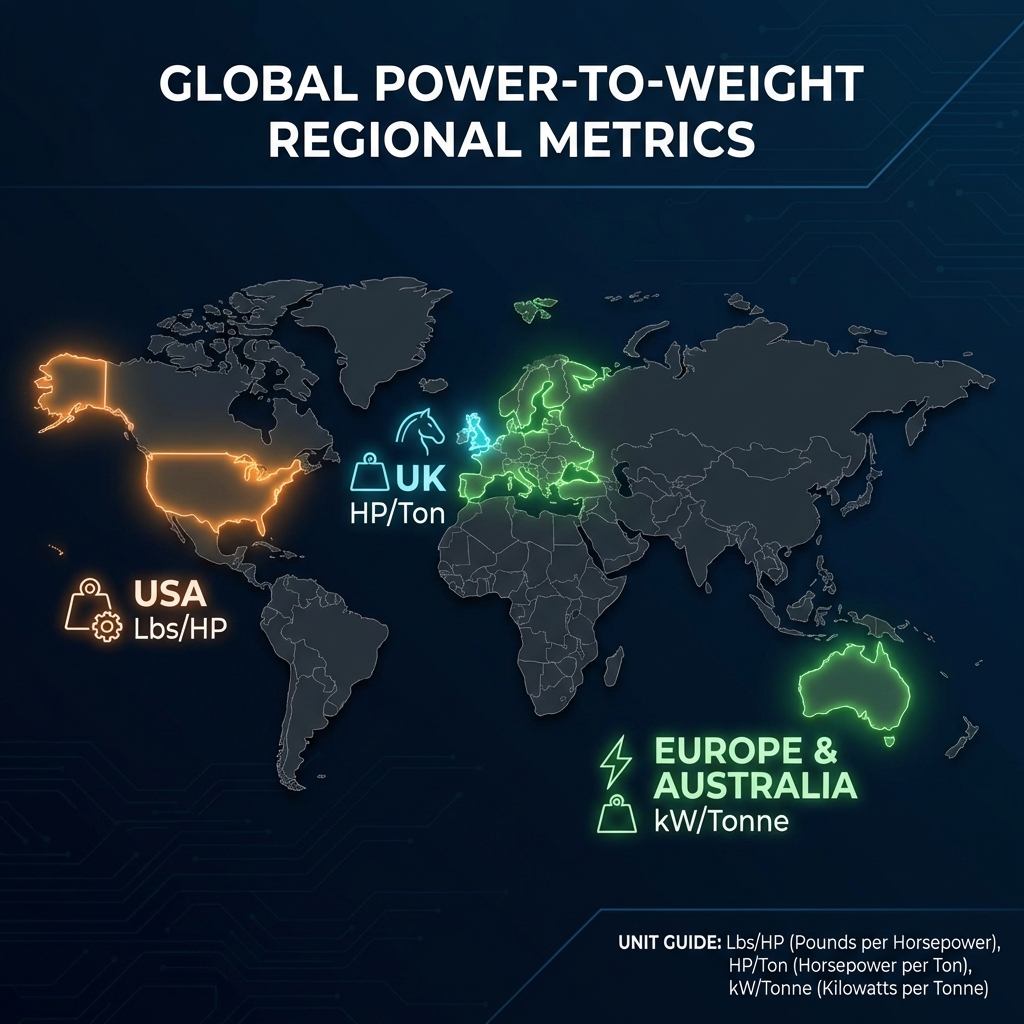
You are reading a car review. The British journalist raves about a car having “250 brake horsepower per tonne.” You switch to an American forum, and they are bragging about “8 pounds per horsepower.” Then you look at Australian laws, and they talk about “130 kilowatts per tonne.”
It’s the same physics, but three different languages. In a globalized car market, understanding these units is critical for comparing performance. Whether you are tuning a track car, buying your first ride on P-Plates, or just arguing in YouTube comments, this guide identifies the truth behind the numbers.
1. The Imperial Contender: Horsepower per Ton (HP/Ton)
Used in: UK, and loosely in general “European” car journalism. The Logic: Higher is Better.
This is the most common metric in international media. It simply asks: If this car weighed exactly 1 ton (1000kg Metric or 2240lbs Imperial—confusion exists here too), how much power would it have?
- Metric Tonne (1000kg): The standard for most modern calculations.
- Imperial Ton (2240lbs): The old British standard, rarely used now but can cause discrepancies.
Benchmark examples (Metric Tonne):
- 100 HP/Ton: Average Economy Car (Toyota Corolla)
- 200 HP/Ton: Fast Sporty Car (Golf R, Mustang GT)
- 500 HP/Ton: Hypercar (Bugatti Veyron)
2. The Metric Master: Kilowatts per Tonne (kW/t)
Used in: Australia, South Africa, New Zealand, Scientific Papers. The Logic: Higher is Better.
This is the SI (System International) standard. It is the most scientifically accurate because a “Horsepower” is a vague unit based on 18th-century ponies, whereas a Watt is a precise definition of energy transfer (Joules per second).
- Conversion: $1 \text{ kW} = 1.341 \text{ HP}$
- Conversion: $1 \text{ HP} = 0.746 \text{ kW}$
Why it matters: In Australia, this unit is Law.
- LAMS (Learner Approved Motorcycle Scheme): Limits riders to 150 kW/t.
- P-Plates (Provisional Drivers): Limits drivers to 130 kW/t (for newer vehicles).
3. The American Standard: Pound per Horsepower (lb/hp)
Used in: USA, Drag Racing. The Logic: LOWER is Better.
The US refuses to conform. Instead of asking “how much power for a fixed weight?”, they ask “how much weight does each horse have to carry?” The “Power Loading” concept comes from aviation.
- 15 lbs/hp: Slow / Average.
- 10 lbs/hp: The “Golden Line” for sports cars. If you break into the single digits (9.9 lbs/hp), you are fast.
- 5 lbs/hp: Insanity. (Top Fuel Dragsters are roughly 0.2 lbs/hp).
How to Convert Between Them
Here is your cheat sheet for translating car stats.
To get kW/Tonne (from HP/Ton)
$$ \text{HP/Ton} \times 0.746 $$ Example: $300 \text{ HP/Ton} \times 0.746 = 223.8 \text{ kW/t}$
To get HP/Ton (from Lbs/HP)
$$ \frac{2205}{\text{Lbs/HP}} $$ (Note: 2205 is the lbs in a Metric Tonne) Example: Car has $10 \text{ lbs/hp}$. $2205 / 10 = 220.5 \text{ HP/Ton}$.
To get Lbs/HP (from HP/Ton)
$$ \frac{2205}{\text{HP/Ton}} $$ Example: Car has $500 \text{ HP/Ton}$. $2205 / 500 = 4.41 \text{ Lbs/HP}$.
Why the Difference Matters (Marketing vs. Engineering)
Marketing departments love HP/Ton. It produces a big, impressive number. “500” looks better than “4.4”. Engineers often prefer kW/Tonne because it aligns with calculations for acceleration force ($F=ma$) and kinetic energy ($KE = \frac{1}{2}mv^2$) without arbitrary conversion factors.
However, for the driver, Lbs/HP (or Kg/kW) offers a very visceral visualization. Imagining a single horse trying to drag 10 lbs vs 20 lbs gives an instant sense of the engine’s struggle.
Conclusion
The next time you see a spec sheet, check the units. A “150” power to weight ratio could be a slow motorcycle (150 HP/Ton is okay) or a lightning-fast rocket (150 kW/t is ~200 HP/Ton). Context is everything.
Regardless of the unit, the physics remains: Power makes headlines, but weight determines the deadline.
? Frequently Asked Questions
What is 1 kW in HP?
Which is better: higher or lower lbs/hp?
What is the P-Plate power to weight limit in Australia?
How do I convert HP/Ton to kW/Tonne?
Why does America use Lbs/HP?
What is a supercar ratio?

About Azeem Iqbal
We are dedicated to providing accurate tools and information to help you optimize performance and understand power-to-weight metrics.