How to Calculate Power to Weight Ratio for Cars (Hp/Ton)
Step-by-step guide to calculating your cars power to weight ratio. Understand Hp per Ton, curb weight vs. dry weight, and how to estimate 0-60 times from one simple number.
Azeem Iqbal
Performance Analyst
How to Calculate Power to Weight Ratio for Cars (Hp/Ton)
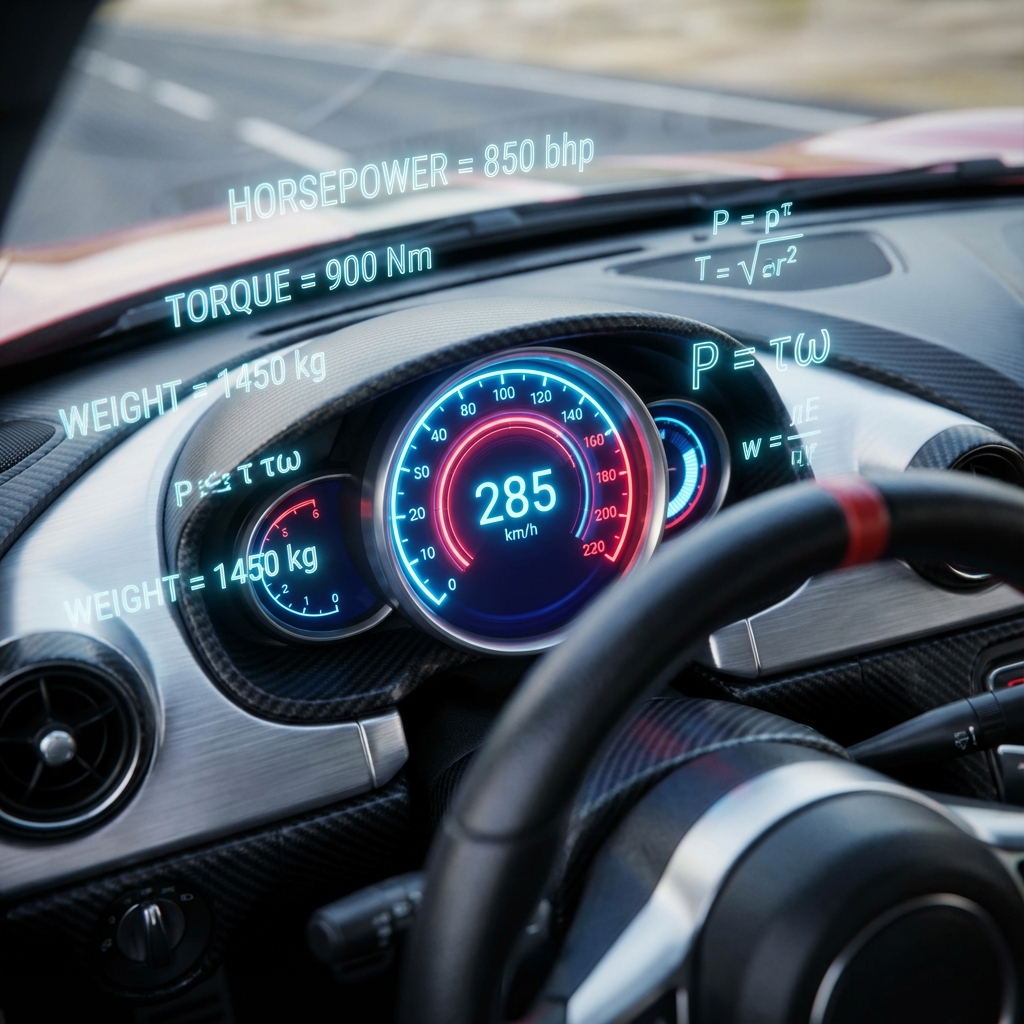
If you hang around car meets or read automotive forums, you’ll eventually hear someone brag about their “Horsepower per Ton.” Unlike peak horsepower, which is just a marketing number, Power to Weight Ratio (PWR) is the true equalizer. It explains why a 200 hp Lotus Elise can keep up with a 400 hp Mustang on a track.
In this guide, we will walk you through exactly how to calculate this metric for any car, explain the difference between confusing weight terms, and help you estimate your 0-60 mph time.
Why Horsepower Isn’t Enough
Imagine two engines sitting on a shop floor. One produces 500 hp, the other 250 hp. Which one makes for a faster car?
You can’t answer that until you know what they are pushing.
- The 500 hp engine is in a 5,000 lb luxury SUV.
- The 250 hp engine is in a 2,000 lb track toy.
The SUV has to move 10 lbs for every horsepower ($5000 / 500 = 10$). The track toy only moves 8 lbs for every horsepower ($2000 / 250 = 8$).
Despite having half the power, the track car has a superior power-to-weight ratio. It will accelerate harder, stop shorter, and turn sharper.
Step 1: Find Your Numbers
To get an accurate result, you need accurate inputs.
1. Engine Power (Horsepower or Kilowatts)
This is usually the easiest number to find. Use the manufacturer’s rated “Brake Horsepower” (bhp) or Kilowatts (kW).
- Note: If you have modified your car (tune, intake, exhaust), use your dyno-proven wheel horsepower numbers for a “real world” result, but remember that factory specs usually quote “crank” horsepower (at the engine).
2. Vehicle Weight (Curb vs. Dry)
This is where most people get it wrong. Manufacturers love to quote “Dry Weight” because it makes the car sound lighter.
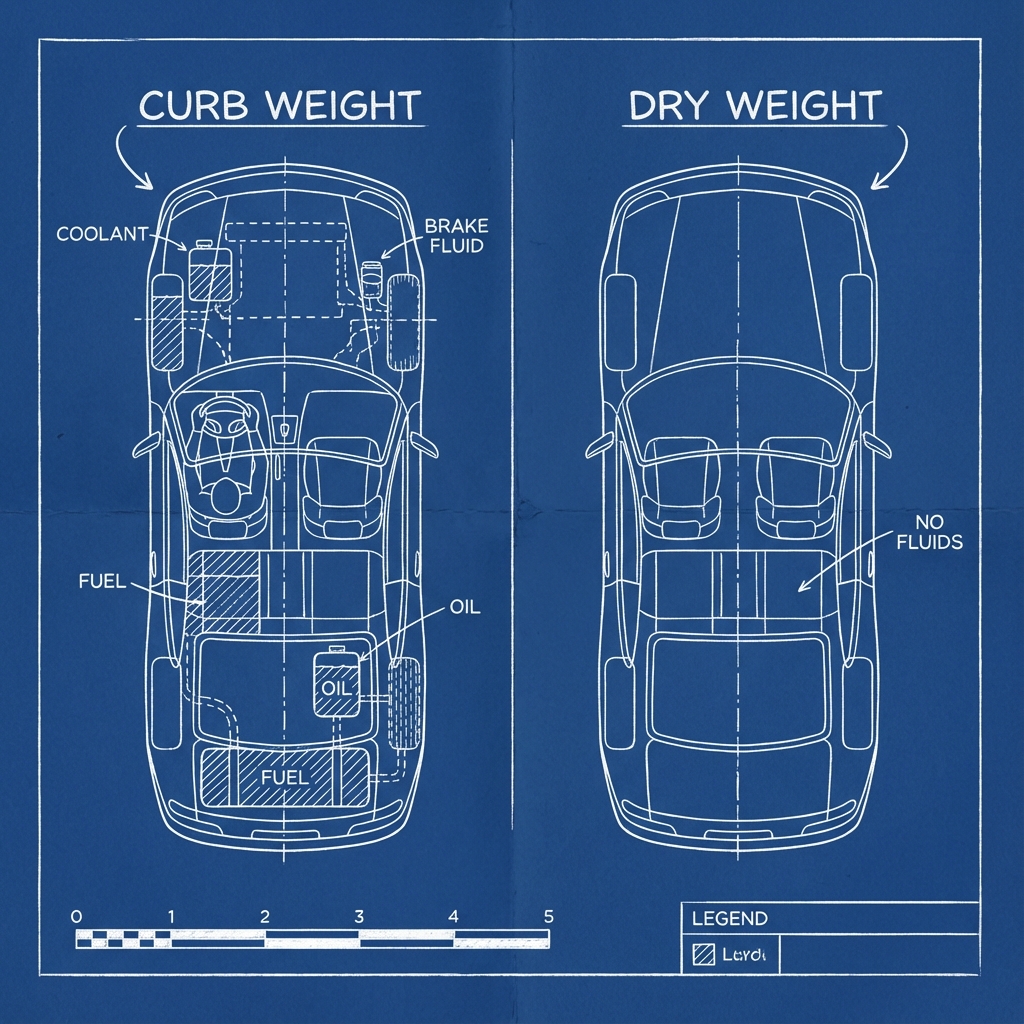
- Dry Weight: The weight of the car with NO fluids (no gas, no oil, no coolant, no brake fluid). You cannot drive a dry car.
- Curb Weight: The weight of the car ready to drive, with a full tank of gas and all fluids topped up.
- Gross Vehicle Weight Rating (GVWR): The maximum weight the car can safely carry (car + passengers + cargo). Do not use this.
Rule of Thumb: Always use Curb Weight. If you really want to be precise, take your car to a weighbridge with you in the driver’s seat.
Step 2: The Calculation
Depending on where you live, you’ll use different units.
The Imperial Method (USA/UK)
The standard is Horsepower per Ton.
- In the US, a “Ton” is usually a Short Ton (2,000 lbs).
- In the UK, a “Ton” is often a Long Ton (2,240 lbs).
- Sometimes, enthusiasts simply use Pounds per Horsepower (lb/hp).
Formula A: Horsepower per Ton (US) $$ \text{Hp/Ton} = (\frac{\text{Horsepower}}{\text{Weight in lbs}}) \times 2000 $$
Formula B: Pounds per Horsepower $$ \text{lb/hp} = \frac{\text{Weight in lbs}}{\text{Horsepower}} $$ Lower is better for lb/hp.
Example:
- Car: 2024 Ford Mustang GT
- Power: 480 hp
- Weight: 3,800 lbs
$$ \text{Hp/Ton} = (\frac{480}{3800}) \times 2000 = \textbf{252.6 hp/ton} $$ $$ \text{lb/hp} = \frac{3800}{480} = \textbf{7.9 lb/hp} $$
The Metric Method (Rest of World)
The standard is Kilowatts per Tonne (kW/t).
- 1 Tonne = 1,000 kg.
Formula: $$ \text{kW/t} = (\frac{\text{Power in kW}}{\text{Weight in kg}}) \times 1000 $$ (Or simply Power in kW divided by Weight in Tonnes)
Example:
- Car: Hyundai i30 N
- Power: 206 kW
- Weight: 1500 kg (1.5 tonnes)
$$ \text{kW/t} = \frac{206}{1.5} = \textbf{137.3 kW/t} $$
Estimating 0-60 Time from Weight Ratio
While not a perfect science (traction limits apply!), PWR is a great predictor of straight-line acceleration. Here is a rough cheat sheet for street cars using street tires:
| Hp / Ton (US) | lb / hp | Est. 0-60 mph | Car Tier |
|---|---|---|---|
| < 100 | > 20 | 10.0s + | Economy / City Car |
| 120 | ~16 | 8.0s - 9.0s | Standard Sedan |
| 170 | ~11.5 | 6.5s - 7.5s | Hot Hatch / Sporty Sedan |
| 250 | ~8.0 | 4.5s - 5.5s | Sports Car / Muscle Car |
| 400 | ~5.0 | 3.0s - 3.8s | Supercar |
| 600+ | < 3.3 | < 2.9s | Hypercar / Superbike |
Limitations of the Logic
While Power to Weight is king, it isn’t the only ruler in the kingdom.
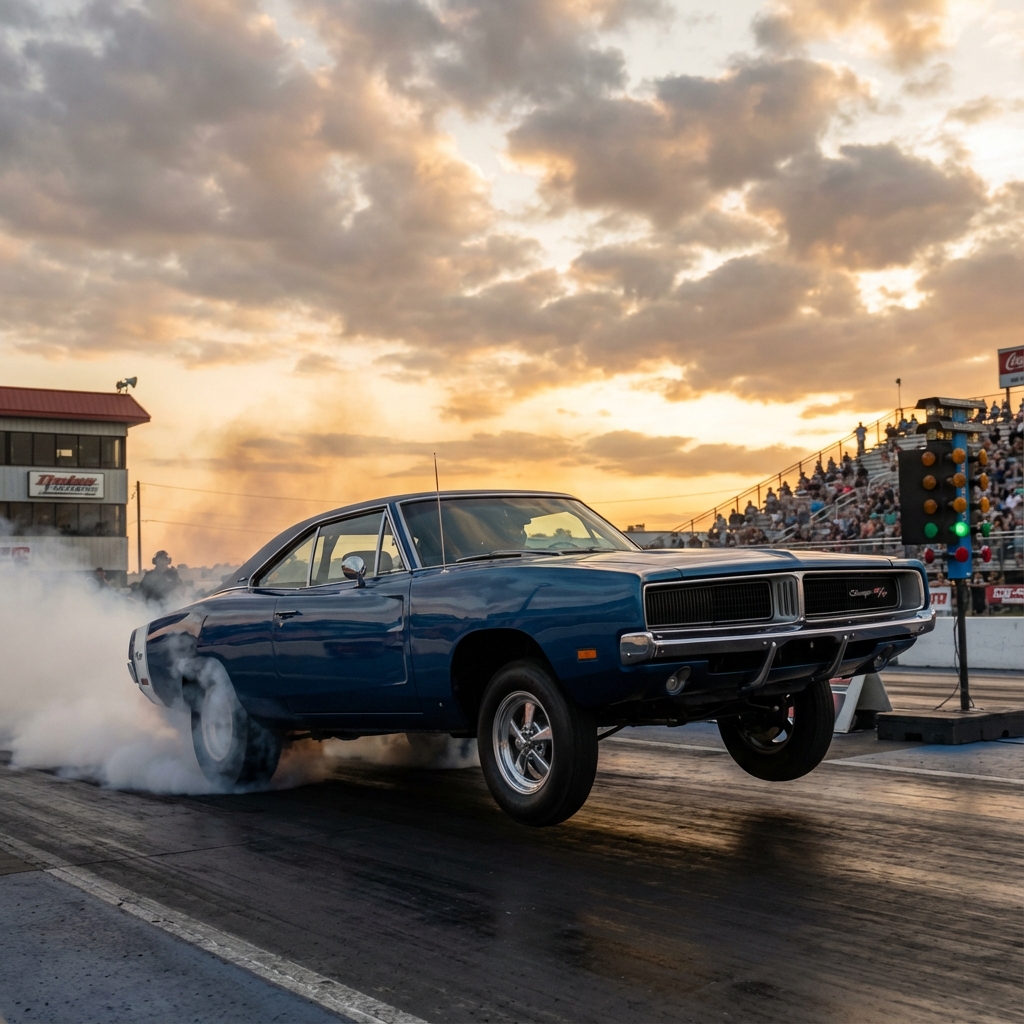
- Grip: A 1000 hp car with skinny tires will just spin. AWD cars can launch faster with lower PWR than RWD cars with higher PWR.
- Aerodynamics: Above 100 mph, drag becomes the dominant force, not weight.
- Gearing: Short gears accelerate faster; tall gears are for fuel economy.
Conclusion
Calculating your car’s power to weight ratio is the best reality check for performance. It cuts through the marketing hype and tells you the raw potential of the machine. Whether you are looking to buy a new car or tuning your current project, aim to improve your Hp/Ton—either by adding boost or stripping weight.
Ready to check your stats? Use our Power to Weight Calculator at the top of the page to get your instant results.
? Frequently Asked Questions
What is a good hp/ton for a street car?
Should I use curb weight or dry weight?
How do I convert kW/t to hp/ton?
Does torque matter for power to weight ratio?
Can I calculate 0-60 time from power to weight ratio?

About Azeem Iqbal
We are dedicated to providing accurate tools and information to help you optimize performance and understand power-to-weight metrics.