Power to Weight Ratio vs. Acceleration: The Truth About 0-60
Why do some 500hp cars run 10s quarters while others run 12s? We dive into the physics of acceleration, traction tables, and why dyno numbers rarely tell the whole story.
Azeem Iqbal
Performance Analyst

Power to Weight Ratio vs. Acceleration: The Truth About 0-60
The “zero to sixty” sprint is the yardstick of the automotive world. It is the number everyone brags about. But have you ever noticed how some cars with less power are actually faster than cars with massive engines?
The answer lies in the Law of Acceleration, which is essentially Newton’s Second Law: $F = ma$. But in the real world of tire smoke and asphalt, it’s a little more complicated variables.
The Physics of the Launch
Acceleration is simply Force divided by Mass.
- Force: The torque your engine sends to the wheels.
- Mass: The weight of your car.
Therefore, to accelerate faster, you must either increase force (more power) or decrease mass (less weight). This is why Power to Weight Ratio (PWR) is the “Golden Ratio” of drag racing.
The “Decay” of Speed
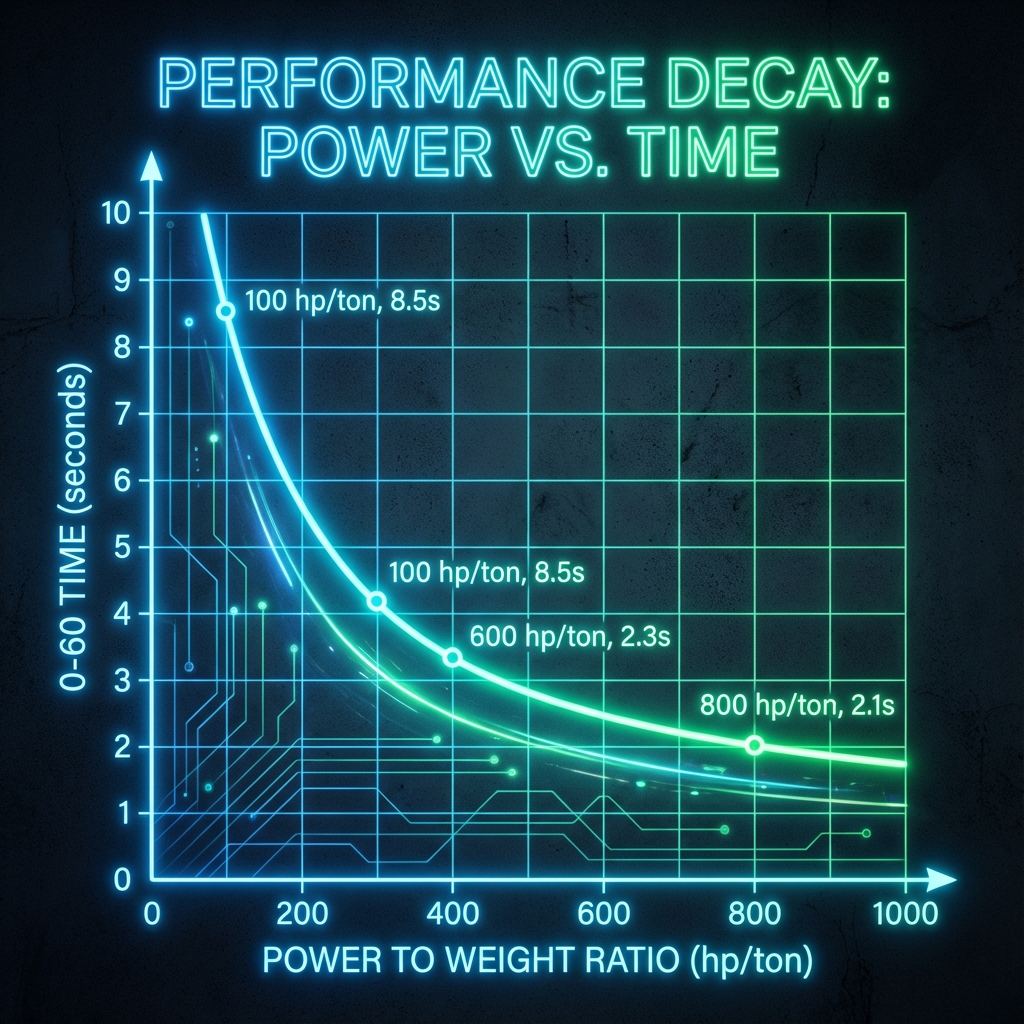
The relationship between PWR and 0-60 time is not linear; it’s exponential.
- Going from 100 hp/ton to 200 hp/ton might drop your time by 3 seconds (e.g., 9s to 6s).
- Going from 500 hp/ton to 600 hp/ton might only drop it by 0.2 seconds (e.g., 2.5s to 2.3s).
As you get faster, air resistance and tire limits provide diminishing returns.
The Variables You Can’t Ignore
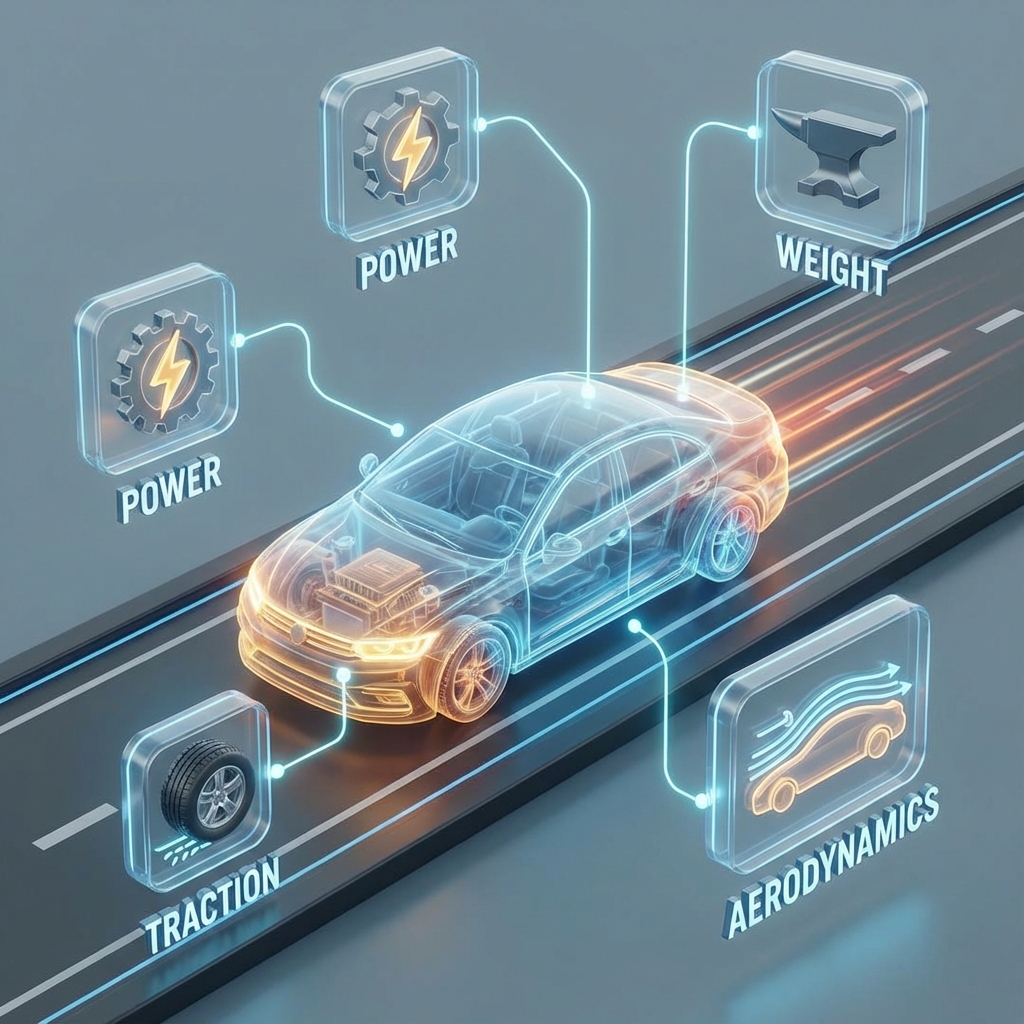
While PWR is the potential, these factors determine the reality:
1. Traction (The Great Equalizer)
You can have 1000 hp/ton, but if you have bicycle tires, you aren’t going anywhere.
- RWD (Rear Wheel Drive): Limited by the weight transfer to the rear tires.
- AWD (All Wheel Drive): Can put power down to four corners, effectively doubling the grip limit at launch. This is why a Nissan GT-R (heavy, lower PWR) often beats lighter supercars off the line.
2. Gearing
If you have to shift gears twice to hit 60 mph, you are losing precious tenths of a second. Modern dual-clutch transmissions (DCT) shift in milliseconds, whereas a manual gearbox requires human intervention.
3. Aerodynamics
Below 60 mph, aero drag is negligible. Above 100 mph, it is everything. This is why a brick-shaped SUV might be fast to 60 (thanks to AWD and Torque) but slow to 150 (because the air wall hits it hard).
Conclusion
Power to Weight Ratio gives you the Physics Potential of a vehicle. But Traction gives you the Real World Result. If you want a fast street car, aim for a balanced PWR (approx 200-300 hp/ton) and excellent tires. If you want a fast race car, strip every pound of weight you can find.
? Frequently Asked Questions
Does power-to-weight ratio directly determine 0-60 time?
How much horsepower do I need for a 3-second 0-60?
Why does acceleration "decay" at higher speeds?
What is "Hooking Up" in racing terms?
Is torque more important than horsepower for 0-60?

About Azeem Iqbal
We are dedicated to providing accurate tools and information to help you optimize performance and understand power-to-weight metrics.